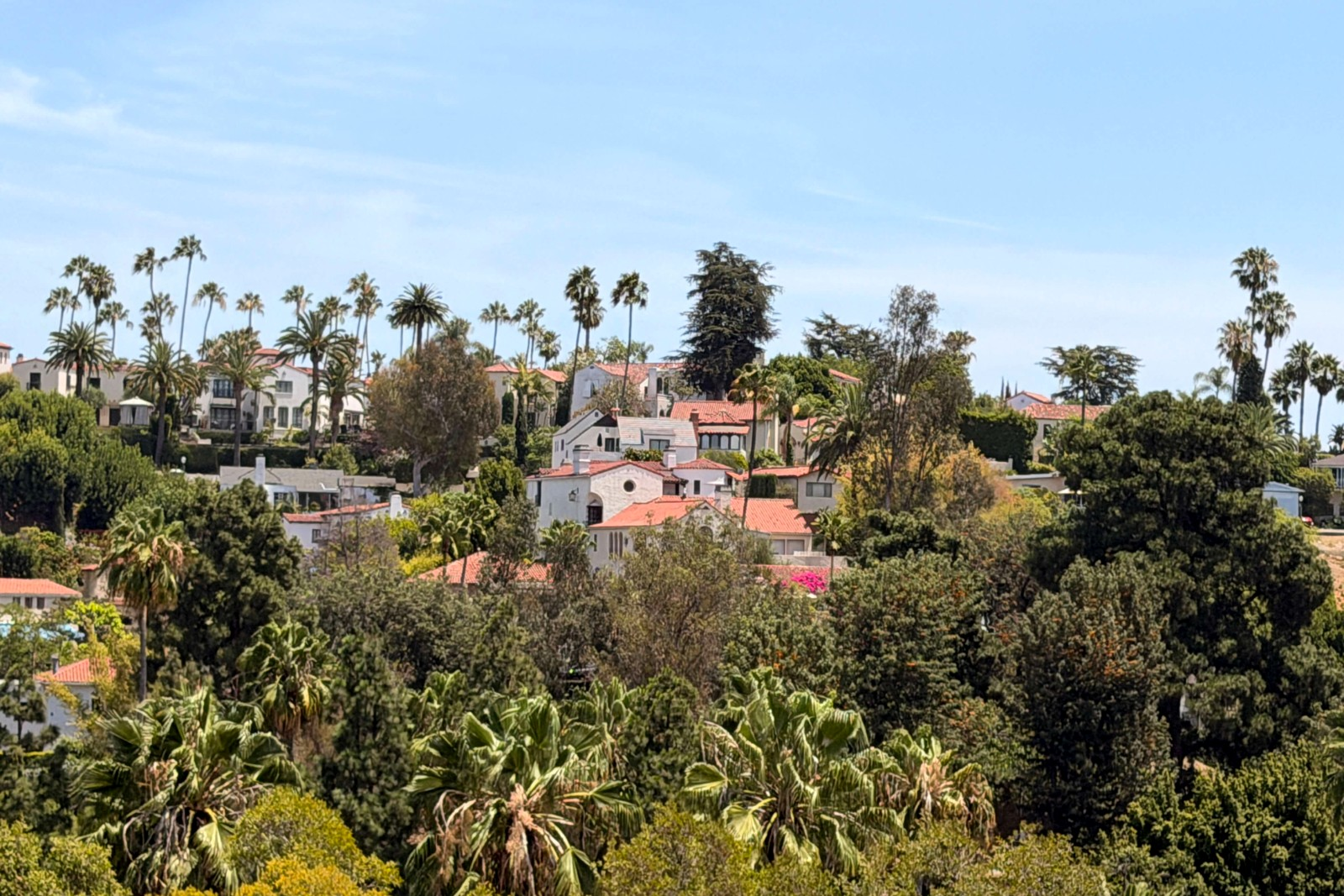
Above Franklin Avenue and just east of the Hollywood Bowl, Whitley Heights was built to look like a village on the Italian coast. Between 1918 and 1928, developer H.J. Whitley and architect Arthur S. Barnes created Hollywood’s first celebrity neighborhood, and silent film stars moved in almost immediately.
A century later, it is one of the most protected residential neighborhoods in Los Angeles. For buyers, that means a historic streetscape that cannot be built over. For sellers, it means a buyer pool that values exactly what you own.

Quick Facts
Location: Hollywood Hills, Los Angeles, ZIP 90068, north of Franklin Avenue and east of the Hollywood Bowl
Developed: 1918 to 1928 by H.J. Whitley
Architect: Arthur S. Barnes designed most of the original homes
Style: Mediterranean, Spanish Colonial and Mission Revival
Civic Association: Founded in 1923
Historic Status: National Register Historic District (1982), the first in Hollywood · City of Los Angeles HPOZ
Notable Residents: Rudolph Valentino · Charlie Chaplin · Gloria Swanson · Bette Davis · Carole Lombard · Barbara Stanwyck · William Faulkner · Ronald Reagan
Market Snapshot: ZIP 90068 median sale price of $1,734,608 in June 2026, all home types (Redfin)
Why Whitley Heights performs in the market
Whitley Heights combines three things buyers cannot manufacture: a fixed hillside footprint, a century of Hollywood history, and layers of preservation that protect the look of every street. When a period home with a view comes to market here, it competes with almost nothing else in Los Angeles.
It is also close to everything. The Hollywood Bowl is next door, and Hollywood Boulevard and the Metro B Line are a short walk downhill.
H.J. Whitley’s Mediterranean village
Hobart Johnstone Whitley, a Canadian-born developer who had already founded railroad towns and helped open the Hollywood Hotel, saved this hillside for his final project. In 1918 he commissioned architect Arthur S. Barnes, who toured the hill towns of Italy before designing most of the neighborhood’s homes. The subdivision opened with a barbecue in June 1920, and the Whitley Heights Civic Association was founded in 1923.
Hillside development was new to Los Angeles, so the neighborhood was engineered from scratch: graded roads that follow the contours, retaining walls, iron chain railings, and public stairways in place of sidewalks. Height limits protected each home’s view of the city.
Famous residents
Whitley Heights became Hollywood’s first celebrity enclave because it was minutes from the studios. Rudolph Valentino and Natacha Rambova, Charlie Chaplin, Gloria Swanson and Norma Talmadge lived here in the silent era. Bette Davis, Carole Lombard, Barbara Stanwyck, Rosalind Russell, Janet Gaynor and Carmen Miranda followed. William Faulkner and F. Scott Fitzgerald wrote here, and Ronald Reagan lived here during his years as an actor.
The freeway and the preservation movement
In the 1940s, the Hollywood Freeway was cut through the original neighborhood, destroying dozens of homes, including Valentino’s house on Wedgewood Place. Those losses created the preservation movement that protects the neighborhood today. In 1982, Whitley Heights became Hollywood’s first district on the National Register of Historic Places, and the City of Los Angeles later added a Historic Preservation Overlay Zone (HPOZ).
Buying in an HPOZ: what to know
An HPOZ protects the neighborhood’s character, and it shapes what owners can change. Exterior work visible from the street, including windows, additions and some landscaping, goes through review against the Whitley Heights Preservation Plan. Interiors are generally the owner’s to update. Factor review time into renovation plans, and ask for the permit history on any prior work.
Some homes also carry a Mills Act contract, California’s leading preservation incentive. In Los Angeles it is a ten-year, automatically renewing contract that can lower property taxes in exchange for maintaining the home’s historic character, and it transfers to the new owner at sale. A few homes, including 2001 Holly Hill Terrace, are also protected by a permanent Los Angeles Conservancy facade easement.
Market behavior: what Whitley Heights teaches buyers and sellers
For buyers: Treat the protections as assets. They preserve the character you are paying for, and a transferable Mills Act contract can lower your carrying cost. Have a tax advisor model the savings and review the preservation plan before you write an offer.
For sellers: Document everything. Mills Act paperwork, permit history, easements and the home’s ownership story all widen the buyer pool. In Whitley Heights, provenance is part of the price.
Nearby neighborhoods and homes
- 2001 Holly Hill Terrace, a 1924 Whitley Heights villa once home to Jane Fonda and Roger Vadim
- Hollywood Heights, the hillside village across Highland Avenue
- The DeMille Estate, Mediterranean Revival at estate scale in Laughlin Park
- Hollywood Hills Historic Homes: Complete Guide
- Buying a historic home in Los Angeles: HPOZ rules, the Mills Act and due diligence
Why Whitley Heights still matters
- First of its kind: Hollywood’s first celebrity neighborhood and its first National Register historic district.
- Protected streetscape: HPOZ review keeps every street looking like Whitley intended.
- Tax advantages: Mills Act contracts on qualifying homes can lower carrying costs.
- Location: Next to the Hollywood Bowl and a short walk from Hollywood Boulevard.
I specialize in Whitley Heights and currently represent 2001 Holly Hill Terrace. If you are thinking about buying or selling here, contact me.
All home images are artistic illustrations used for historical and educational commentary.
