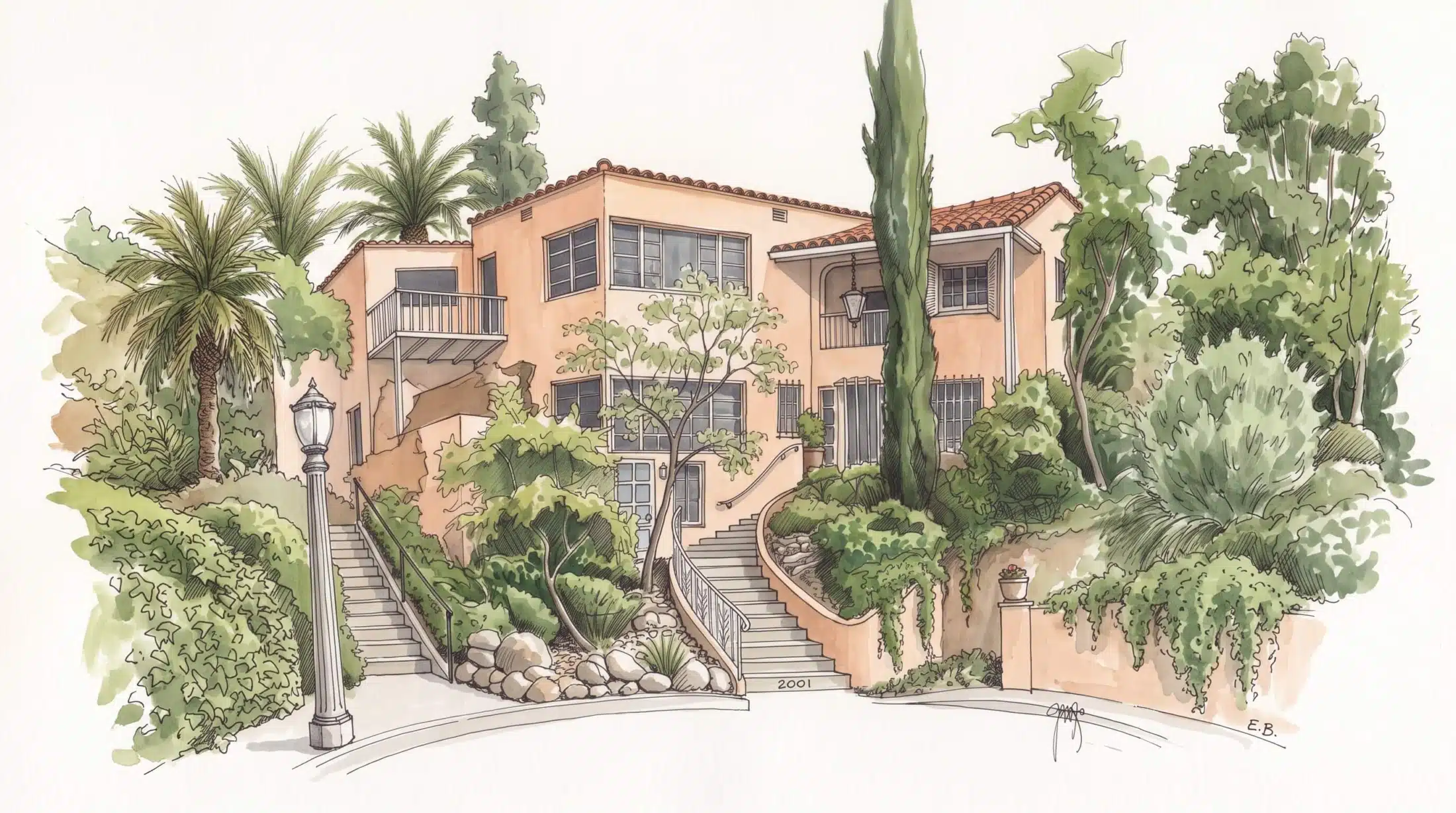
At the end of a peaceful cul-de-sac in Whitley Heights, Hollywood’s first celebrity neighborhood, 2001 Holly Hill Terrace sits exactly where H.J. Whitley intended his homes to sit: high, terraced, and facing the city like a villa above a Mediterranean harbor. Built in 1924, it was once home to Jane Fonda and Roger Vadim, it appears by address in a declassified CIA file, and it spent the next four decades in the hands of a Hollywood acting family.
For buyers and sellers, this house makes a point that applies across the Hollywood Hills: protection is a form of value. A National Register district, a city preservation overlay, a permanent LA Conservancy facade easement, and a Mills Act contract all sit on this one address. History brought the attention. The protections keep the story intact for the next owner.

Quick Facts
Address: 2001 Holly Hill Terrace, Los Angeles, CA 90068
Built: 1924
Neighborhood: Whitley Heights, developed by H.J. Whitley between 1918 and 1928 as a Mediterranean hillside village
Style: Mediterranean Revival, smooth stucco, L-shaped plan that follows the lot, two-story veranda added in 1941
Size: Approx. 4,241 sq ft across three levels, 5 bedrooms, 5 baths
Lot: Under a quarter acre at the end of a cul-de-sac, with two street entrances (Holly Hill Terrace and Grace Avenue)
Key Features: Grand staircase entry, formal dining room with stained-glass sidelights, library opening to a canyon-view patio, freeform pool and spillover spa, terraced gardens with mature fruit trees, summer kitchen, guest suite with private entrance and full kitchen
Notable Residents: Jane Fonda & Roger Vadim · Jane Fonda & Tom Hayden · Actors Bryan & Jo Deodato Clark · Kathleen & Tom Whyte
Historic Protections: LA Conservancy facade easement · Mills Act contract · Whitley Heights HPOZ · National Register Historic District
Recent Market Milestones: Listed October 2026 at $1,995,000, featured in the NY Post, Robb Report, and Parade
Status: In one family for 41 years, now offered through Douglas Elliman
Why this property performs in the market
Most homes in the Hollywood Hills compete on views and square footage. 2001 Holly Hill Terrace competes on something buyers cannot add later: a century of documented Hollywood history on a protected footprint. Whitley Heights is small, hemmed in by the Hollywood Bowl to the west and the freeway that carved through it in the 1940s. New supply is effectively impossible. When a period villa with a pool and terraced gardens comes to market here, it is competing with almost nothing.
The price point matters too. Under $2 million, this is one of the rare ways into a named, documented Hollywood house without entering the trophy market. That combination, provenance at an attainable number, is exactly what national press responds to, and it is why the NY Post, Robb Report, and Parade all covered the listing within a week.
H.J. Whitley’s last act: a Mediterranean village above Hollywood
Hobart Johnstone Whitley, the Canadian-born developer and banker who had already built railroad towns across the West and helped open the Hollywood Hotel on Highland Avenue, saved this hillside for last. In 1918 he commissioned architect Arthur S. Barnes to design it as a Mediterranean hillside village. Barnes toured the hill towns of Italy first, and returned to design most of the neighborhood’s homes between 1918 and 1928.
The engineering was new for Los Angeles. Hillside development was still unproven, so Whitley Heights was built with graded roads that follow the contours, stone retaining walls, iron chain railings, and public stairways in place of sidewalks. Height limits guaranteed that each house kept its view of the city, and design guidelines kept every home reading as a villa. The subdivision opened with a barbecue in June 1920, and the Whitley Heights Civic Association was founded in 1923, one year before 2001 Holly Hill Terrace was completed. That association still exists today and is led by the home’s current owner, Kathleen Whyte.
Whitley called the neighborhood his crowning achievement, and the City of Los Angeles notes that its use of Spanish Colonial and Mediterranean Revival helped popularize those styles across the region. In other words, the look that now defines “old Hollywood” residential architecture was field-tested on this hill.
The architecture: a 1924 villa built to its hill
The house follows Barnes’s village logic. Its L-shaped plan bends to fit an irregular lot, and the smooth stucco exterior, now a soft peach, reads exactly as Whitley intended from the street below. In 1941 a two-story veranda was added to the Mediterranean facade, and that facade, veranda included, is what the LA Conservancy’s easement protects today.
Inside, the plan is built for entertaining. A formal foyer opens to a grand staircase. The main level holds a living room, home office, formal dining room with multi-paned French doors and stained-glass sidelights, a large eat-in kitchen with banquette seating, and a library that opens to a red-brick patio with canyon views. Hardwood floors and high ceilings run throughout. Upstairs, the primary suite has a sitting room and a private deck looking into the treetops and the canyon. On the lower level, a guest suite with its own entrance, full kitchen, and laundry gives family and visitors real privacy.
The grounds are the headline. Behind the house, terraces step down the hillside to a freeform pool and spillover spa, a tiled sundeck, an elevated lounging deck, and a summer kitchen with a built-in grill, all framed by gardens and mature fruit trees. The site is reached from two levels: a staircase from Holly Hill Terrace to the formal entry, and a two-car garage off Grace Avenue at the top of the house.
In Laughlin Park, the DeMille Estate shows how Mediterranean Revival terraces turn elevation into long-term value at the top of the market. Holly Hill Terrace applies the same idea at a fraction of the scale.
Jane Fonda, Roger Vadim, and the CIA file
The house was once home to Jane Fonda and Roger Vadim, the French director she married in 1965 and who directed her in Barbarella (1968). Fonda rented rather than owned the house. According to Los Angeles city planning documents reported by the NY Post, she also lived here with her second husband, the activist and later California legislator Tom Hayden, whom she married in 1973 just after her divorce from Vadim was finalized.
These were the years of Fonda’s most public anti-war activism, and the government was watching. A CIA document declassified in 2018 lists Fonda’s name and this Holly Hill Terrace address as number 22 of 50 names and addresses the agency tracked in 1971. Under a mail-opening program that ran from the 1950s until 1973, the CIA intercepted and opened four letters sent to her from the Soviet Union. Robb Report also notes that the FBI tapped her phone lines during this period. In 1975, CIA Director William Colby reportedly told President Gerald Ford, “That is illegal and we stopped it in 1973.”
For a buyer, this is not gossip. It is a documented, government-recorded link between a specific address and one of the defining cultural figures of the 20th century. Very few homes at any price can point to a primary source like that.
The Clark family era: Hollywood’s working actors
In 1985 the house was purchased by Bryan Clark and Jo Deodato Clark, both Hollywood character actors. Bryan Clark (1929 to 2022) appeared in All the President’s Men and Trading Places, played Earl the bartender on Cheers, served as a national spokesman for Folgers Coffee in the 1980s, and became known for portraying President Ronald Reagan, including in Guts and Glory: The Rise and Fall of Oliver North (1989) and Without Warning: The James Brady Story (1991).
The irony runs deep. Bryan Clark played Fonda’s ideological opposite on screen while living in the house she once rented. And Reagan himself was a Whitley Heights resident during his own acting years. As I told the NY Post, Reagan lived nearby in a house at the top of the hill when he was a working actor, though I don’t believe the two men ever met.
Today the home is owned by the Clarks’ daughter, Kathleen Whyte, who leads the Whitley Heights Civic Association, and her husband, actor Tom Whyte, known to a generation of fans as Commander Stanton on Power Rangers Lost Galaxy (1999). Kathleen and Tom raised their twins in the house. Counting from 1985, it has been in one family for 41 years.
Famous neighbors over a century
Whitley Heights earned its reputation as Hollywood’s first celebrity enclave in the silent era, when studio talent wanted to live within minutes of the studios. The roster of residents over the years reads like a film history syllabus:
- Silent era: Rudolph Valentino and Natacha Rambova, Charlie Chaplin, Gloria Swanson, Norma Talmadge, Louise Brooks, Barbara La Marr, Francis X. Bushman, Lillian Gish, Harold Lloyd
- Golden Age stars: Bette Davis, Carole Lombard, Barbara Stanwyck, Jean Harlow, Rosalind Russell, Janet Gaynor, Marlene Dietrich, Judy Garland, Carmen Miranda, Tyrone Power, William Powell, W.C. Fields, Marie Dressler, Maurice Chevalier
- Writers: William Faulkner, F. Scott Fitzgerald, Ben Hecht, James Hilton, Anita Loos
- Future president: Ronald Reagan, during his years as a contract actor
- Modern residents: Ellen Pompeo, director Phillip Noyce, actor Patrick Bauchau
The freeway, the fight, and the National Register
Whitley Heights paid a price for progress. In the 1940s the Hollywood Freeway (U.S. 101) was cut through the original neighborhood, destroying dozens of homes, including Valentino’s house on Wedgewood Place and a house associated with Charlie Chaplin. In the early 1960s a home once owned by Bette Davis was demolished for a Hollywood museum that was never built.
Those losses created the preservation movement that now protects the neighborhood. Led by resident Brian Moore, homeowners documented the district’s history, and on August 19, 1982, Whitley Heights was listed on the National Register of Historic Places, the first such district in Hollywood. The City of Los Angeles followed by adopting the Whitley Heights Historic Preservation Overlay Zone (HPOZ), which reviews exterior changes against a neighborhood preservation plan.
The lesson for owners is direct: what was lost is why what remains is scarce. Every surviving Barnes-era villa is one of a fixed and shrinking set.
The protection stack: LA Conservancy, Mills Act, and HPOZ
Few houses in Los Angeles carry as many layers of protection as this one. Each layer does something different for an owner.
LA Conservancy facade easement: 2001 Holly Hill Terrace is one of only two homes in Whitley Heights protected by a Los Angeles Conservancy easement (the other is on Milner Road). A conservation easement is recorded on title and runs in perpetuity, permanently preventing demolition or insensitive alteration of the protected exterior while the owner keeps full ownership. The Conservancy monitors the property and reviews proposed exterior changes against the Secretary of the Interior’s Standards. Interiors and systems remain the owner’s to update within the rules that apply.
Mills Act contract: The Mills Act is California’s leading financial incentive for historic preservation. In Los Angeles it is a ten-year contract between the city and the owner that renews automatically each year, offering a potential property tax reduction in exchange for preserving and maintaining the home’s historic character. The contract transfers to the new owner at sale, so a buyer inherits the contract and its potential tax benefit. City and County officials conduct periodic inspections. Buyers should have their own tax advisor model the savings.
Whitley Heights HPOZ and National Register district: The overlay zone protects the neighborhood around the house. Every neighbor’s exterior is held to the same standard, so the streetscape that gives this address its value is protected too.
Market behavior: what 2001 Holly Hill Terrace teaches buyers and sellers
For buyers: Look past the bedroom count and price the things that cannot be rebuilt. A 1924 Barnes-era villa, a pool and terraced gardens on a protected hillside, a permanent facade easement, and a transferable Mills Act contract are assets, not restrictions. They protect the character you are paying for and, in the case of the Mills Act, can lower your carrying cost.
For sellers: Provenance only works when it is documented. The CIA file, the city planning records, the Conservancy easement, and the Mills Act contract turned this listing from a local sale into a national story. If your home has history, assemble the paper trail before you list. Press follows proof.
Timeline: a century on Holly Hill Terrace
- 1918: H.J. Whitley commissions Arthur S. Barnes to design Whitley Heights as a Mediterranean hillside village
- 1920: The subdivision opens with a barbecue in June
- 1923: The Whitley Heights Civic Association is founded
- 1924: 2001 Holly Hill Terrace is completed
- 1941: The two-story veranda is added to the facade
- 1940s: The Hollywood Freeway cuts through Whitley Heights, destroying dozens of homes
- Early 1970s: Jane Fonda lives here with Roger Vadim, and later with Tom Hayden
- 1971: The CIA lists Fonda’s name and this address among 50 it tracked
- 1982: Whitley Heights is listed on the National Register of Historic Places
- 1985: Actors Bryan and Jo Deodato Clark purchase the house
- 2018: The CIA document naming the address is declassified
- 2026: Offered for sale at $1,995,000 after 41 years in one family
Where 2001 Holly Hill Terrace fits in the Famous Homes map
Holly Hill Terrace belongs to the same 1920s wave that produced the Hollywood Hills’ most storied houses, when film money and new hillside engineering met. Read it alongside these profiles:
- The Storer House, completed the same year, 1924, a few minutes away above Hollywood Boulevard
- The Cedars, a Mediterranean Revival estate built for a silent-film director
- Moorcrest, where Charlie Chaplin and Mary Astor’s family left their mark on Beachwood Canyon
- Castillo del Lago, proof that story, scale, and setting drive value
- Hollywood Hills Historic Homes: Complete Guide
Why 2001 Holly Hill Terrace still matters
- Documented provenance: A declassified CIA record and city planning documents tie this address to Jane Fonda, Roger Vadim, and Tom Hayden.
- Permanent protection: One of only two LA Conservancy easements in Whitley Heights, inside a National Register district and an HPOZ.
- Carrying-cost advantage: A Mills Act contract that transfers to the next owner.
- Irreplaceable setting: A pool and terraced gardens in H.J. Whitley’s Mediterranean village, minutes from the Hollywood Bowl.
- Attainable history: A named Hollywood house under $2 million, a rare entry point into documented provenance.
I represent 2001 Holly Hill Terrace for Douglas Elliman. Private tours are available for prequalified buyers. Connect with me to schedule a showing or request the Mills Act and easement documents.
Weighing a purchase at this level? Start with How to Buy a House in Los Angeles: The Complete 5 Phase Checklist. Selling a historic home of your own? Read why pricing precision matters in 2026.
All home images are artistic illustrations used for historical and educational commentary.
