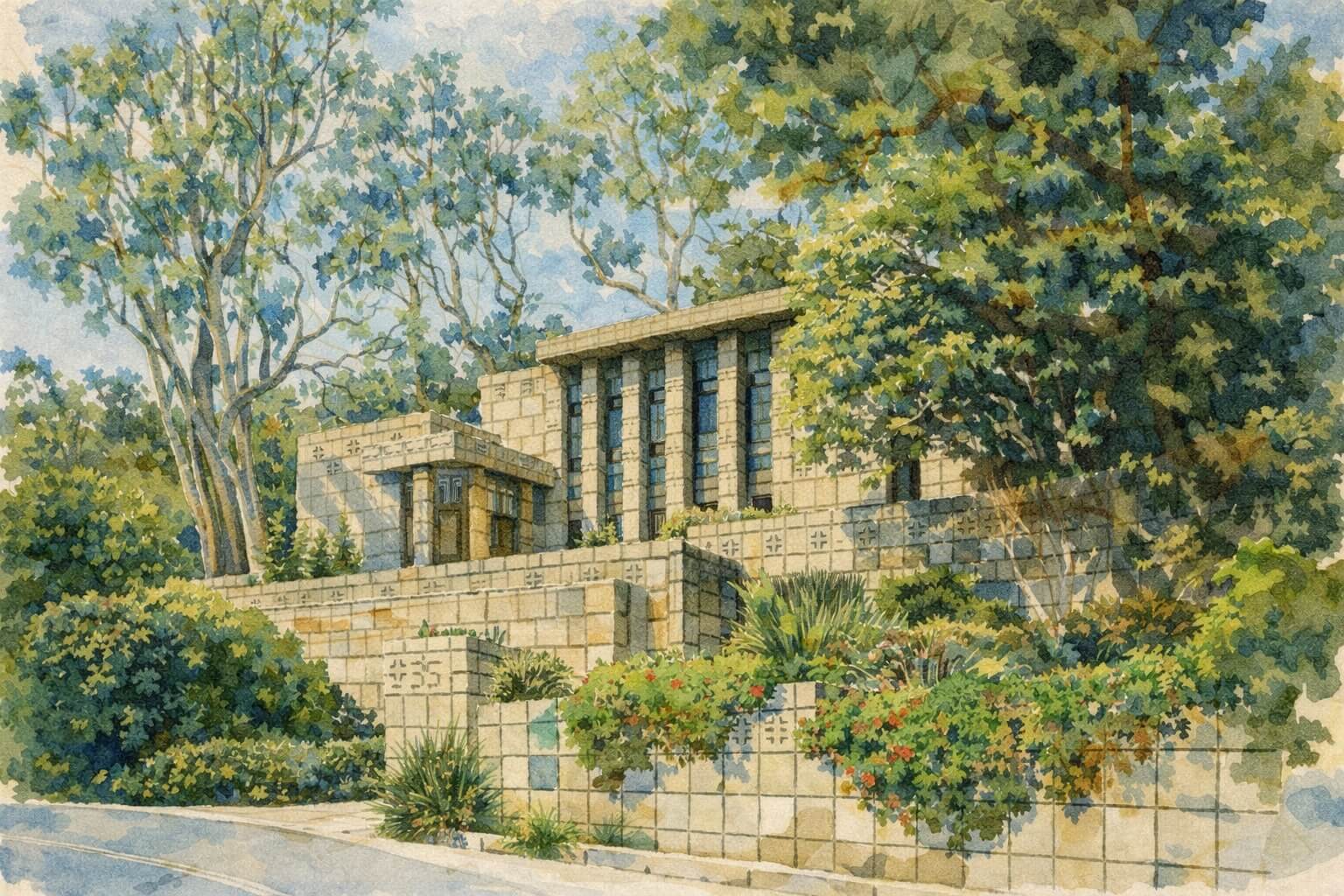
Perched along the steep hillside above Hollywood Boulevard, the Storer House stands as one of the most distinctive and historically important homes in the Hollywood Hills. Designed in 1923 and completed in 1924, the residence emerged during a period when Los Angeles was rapidly redefining itself through architecture, ambition, and risk.
What makes the Storer House compelling today is not simply its architectural pedigree, but how confidently it inhabits its site. Built directly into the slope, the home treats the hillside as an asset rather than an obstacle. That philosophy continues to define many of the most desirable properties in the Hollywood Hills nearly a century later.

Quick Facts
Location: Hollywood Hills, Los Angeles
Address: 8161 Hollywood Boulevard
Designed: 1923
Completed: 1924
Architect: Frank Lloyd Wright
Construction: Patterned concrete “textile block” system with steel reinforcement
Architectural character: Early modernism with strong geometric and pre-Columbian influence
Context: One of four major Los Angeles hillside residences designed during Wright’s textile block period
Why it stands out: A hillside home where structure, ornament, and landscape are inseparable
A home shaped by Los Angeles
The Storer House was commissioned at a moment when Los Angeles was becoming a laboratory for new ideas about how people should live. Hollywood Boulevard below was transforming into the center of the film industry, and the surrounding hills were filling with homes designed to express independence, creativity, and a willingness to break from tradition.
Rather than flattening the terrain, the design embraces it. The house unfolds vertically through stacked volumes, terraces, and shifting vantage points. Outdoor space is treated as part of the architecture itself, a principle that would later become fundamental to Southern California residential design.
Why this architecture still resonates with buyers
The Storer House offers a different kind of luxury than later glass-and-steel hillside homes. Its patterned concrete walls create texture, depth, and shadow, giving the building a sense of permanence and weight. Light filters through the structure rather than simply bouncing off it, creating interiors that feel grounded and intentional.
In the Hollywood Hills, where views often dominate value, homes like the Storer House remind us that architectural character and spatial experience matter just as much. Buyers drawn to these properties are often seeking something more enduring than a trend, a home with identity, history, and presence.
Place within the Hollywood Hills landscape
The Storer House sits comfortably alongside other landmark hillside residences such as the Stahl House, the Lovell Health House, and the Chemosphere. Each represents a different answer to the same challenge: how to live dramatically, comfortably, and intelligently on a steep Los Angeles hillside.
Together, these homes tell the story of why the Hollywood Hills remain one of the most compelling residential landscapes in the city. Architecture, terrain, and cultural history converge here in ways few neighborhoods can replicate.
Why the Storer House still matters
Nearly a century after its completion, the Storer House continues to demonstrate that Los Angeles has long rewarded bold residential ideas. It stands as proof that a home can be experimental, deeply tied to its site, and still feel livable and enduring.
For anyone interested in buying or selling in the Hollywood Hills, homes like this illustrate why location alone is never the full story. Design, history, and how a house engages its landscape all play a role in long-term value and appeal.
Explore more historic homes
Explore more landmark homes and hillside stories throughout Los Angeles in the Hollywood Hills historic homes archive.
All home images are artistic illustrations used for historical and educational commentary.
