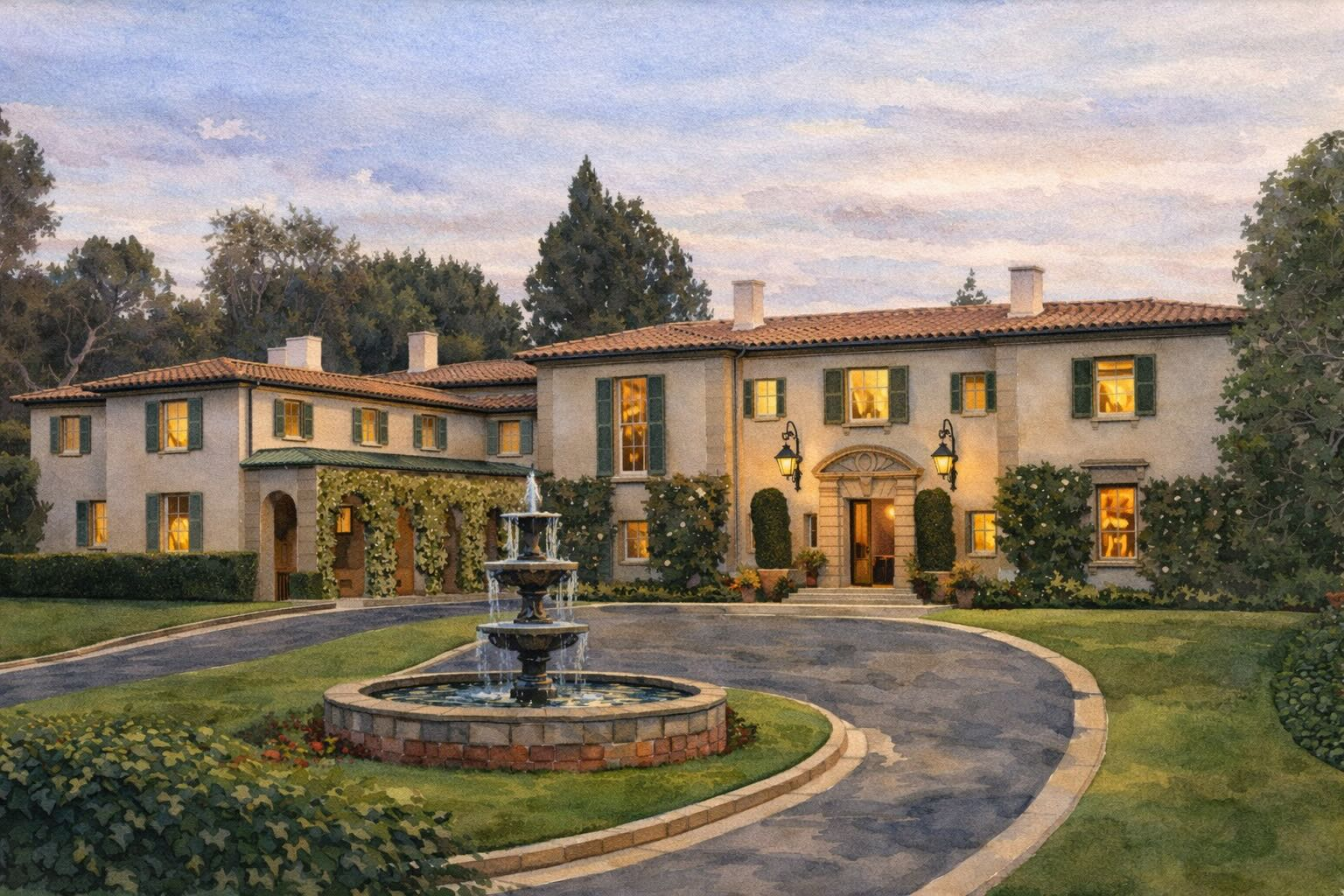
Overview: Owlwood Estate is one of the most important legacy properties in Los Angeles because it combines three things that almost never align at once: an establishment architect (Robert D. Farquhar), a Platinum Triangle address (Holmby Hills), and roughly ten acres of assembled land that cannot be replicated today. The celebrity ownership is real and part of the value, but the deeper story is what Owlwood teaches buyers and sellers about scarcity, privacy, and how trophy assets behave when the market is not simple.
In Holmby Hills, luxury is not the headline. It is the baseline. What separates a true legacy estate from a very expensive house is land configuration, control, and permanence. Owlwood sits in that rare category, and its history reads like a roadmap for how the highest end of Los Angeles real estate actually works.

Quick Facts
Address: 141 S. Carolwood Drive, Holmby Hills, Los Angeles
Architect: Robert D. Farquhar
Era: mid-1930s (commonly cited as 1936 to 1937)
Style: Italian Revival / Italian Renaissance–influenced estate architecture
Main Residence: commonly reported in the ~12,000+ sq ft range (figures vary by outlet)
Land: assembled into a roughly 10-acre compound through later parcel consolidation
Famous Owners: Florence Letts Quinn and Charles H. Quinn; Joseph M. Schenck; Tony Curtis; Sonny Bono and Cher; Roland Arnall (plus other major owners reported over time)
Recent Market Milestones: widely reported $90M sale (2016); public marketing at a far higher ask later; widely reported $88M sale (2020)
Why Owlwood matters in real estate terms
Most write-ups of Owlwood lead with Cher. That is the easy hook. The serious hook is this: Owlwood is one of the clearest examples in Los Angeles of how land assembly multiplies value. Ten assembled acres in Holmby Hills is not a renovation story. It is a scarcity story. Buyers at this level are not only buying a house, they are buying control of a perimeter.
The architect’s intent: Robert D. Farquhar and permanence
Owlwood was designed by Robert D. Farquhar, a Beaux-Arts–trained architect associated with establishment Los Angeles. His classical discipline shows in the way Owlwood is composed: formal massing, controlled arrival, and a sense of weight that reads as permanent. This is a very different design language than the Modernist movement that later defined many Los Angeles icons, including the homes explored in Lovell Health House and other twentieth-century breakthroughs.
The Arthur Letts origin story
There is one detail that explains why Owlwood’s land has always been treated as a prize: the site was originally selected by Arthur Letts for his own personal estate, but he died before construction began, leaving the project to his widow, Florence. In plain terms, the developer kept the best position for himself. That is not trivia. That is hierarchy, and buyers remember it because it explains why some lots in the Platinum Triangle sit above the rest.
Famous owners, and why each chapter matters
Owlwood’s ownership history is not just name-dropping. It is market memory. Homes that are easy to place in the culture, and easy to tell a clean story about, trade differently than homes that require explanation. That is true at every price point, and it is amplified at the top.
Joseph M. Schenck: Schenck’s chapter ties Owlwood to the machinery of Old Hollywood power. Marilyn Monroe’s connection should be stated precisely: she did not own Owlwood and did not lease it. She was a frequent guest of Schenck and stayed in the guest house. That distinction is exactly the kind of detail that matters when you are writing for serious readers, and it is also why estate narratives must be handled carefully.
Tony Curtis: Curtis pushed Owlwood deeper into celebrity mythology and social history, helping cement the home as something more than an address. Cultural recall becomes real estate leverage when a property returns to market.
Sonny Bono and Cher: Their ownership is the most widely repeated Owlwood chapter because it is sticky. It is also a reminder that prestige property is often about identity as much as architecture. A buyer does not only buy walls. They buy what the house signals.
The ten-acre strategy: the part that changes everything
The most sophisticated part of the Owlwood story is the land. In the early 2000s, Roland Arnall consolidated adjacent parcels, creating the roughly ten-acre compound associated with Owlwood today. In Holmby Hills, even large lots are scarce. A ten-acre assembly is an anomaly. That assembly is why Owlwood sits in its own category.
This is the same underlying principle that makes other giant legacy estates feel inevitable and immovable, including the kind of old-Hollywood scale explored in Greystone Mansion (1928): The Doheny Estate Above Beverly Hills. Land is the ceiling. Everything else is negotiable.
Market behavior: what Owlwood teaches buyers and sellers
Owlwood’s recent public pricing history is a useful reality check. It shows how trophy assets can swing between record sales, ambitious public asks, and later transactions shaped by timing and complexity. At this level, the public sees price. The professionals see structure, access control, and who is actually at the table.
For buyers: prioritize what cannot be recreated, which is land configuration, privacy, and architectural pedigree. That is why an estate like Owlwood has durable gravity even when style trends rotate.
For sellers: narrative control matters. If the story is clean, the buyer pool widens. If the story is messy, the buyer pool narrows. Either way, the job is to manage access and positioning so leverage is not lost early.
Where Owlwood fits in the Famous Homes map
If you want the wider context around how Los Angeles’ most iconic properties evolved, start with the site index at Hollywood Hills Historic Homes: Complete Guide. For a pure Hollywood Hills fairytale with real architectural bite, Moorcrest is the natural companion piece. For a different kind of myth built into the landscape, Castillo del Lago shows how story and setting can become inseparable in this city.
