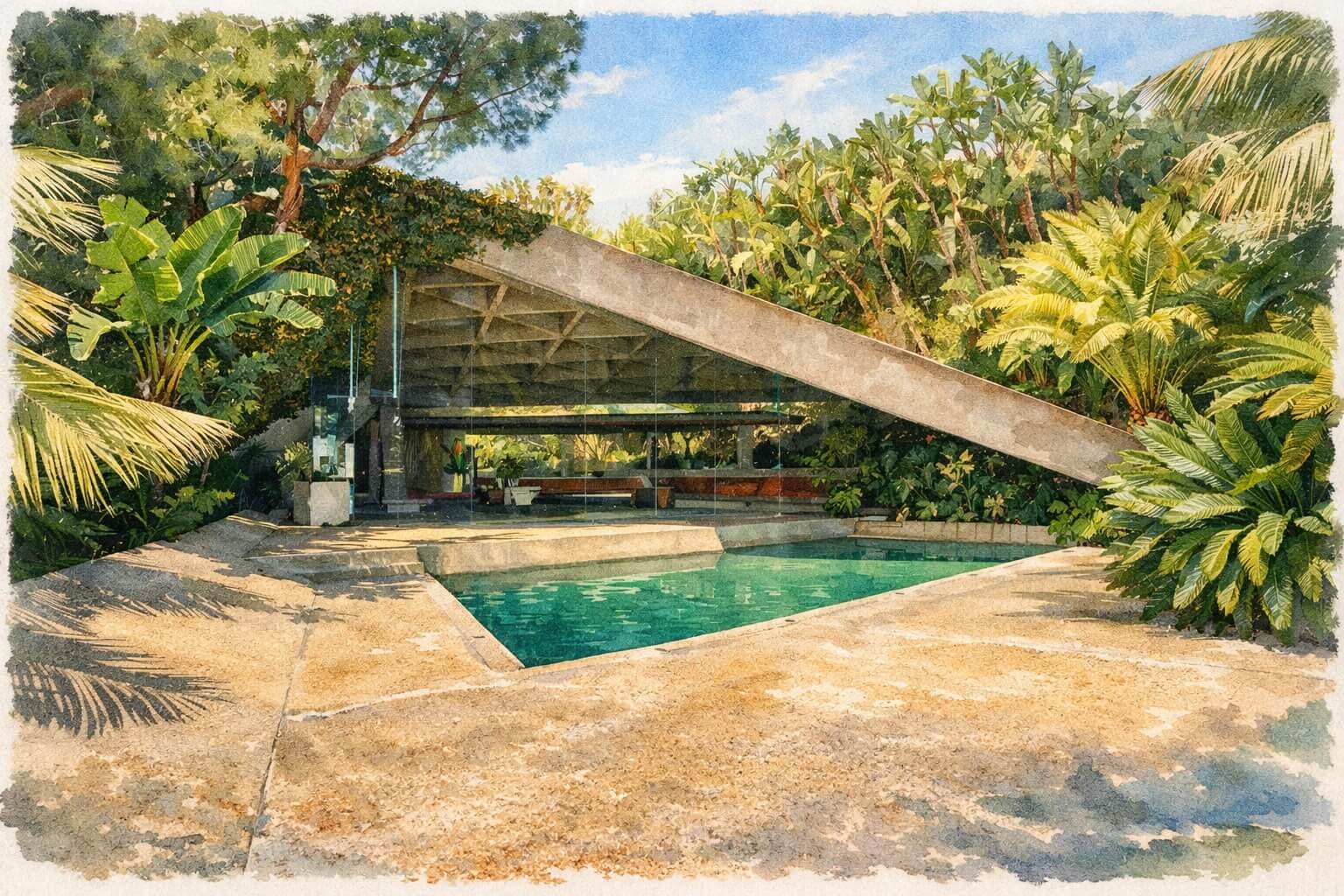
Visiting John Lautner’s Sheats–Goldstein House today.
Cast-in-place concrete and glass, John Lautner’s Sheats–Goldstein House is one of the clearest expressions of his Organic Architecture. Completed in 1963 for Helen and Paul Sheats and later stewarded by James Goldstein, it is not just a famous Hollywood Hills home, it is a permanent cultural artifact. Goldstein’s donation of the property to LACMA effectively removed it from the private market forever, guaranteeing long-term preservation and elevating its cultural gravity in a way very few residences ever achieve.

Quick Facts
Name: Sheats–Goldstein House (also widely known as the Goldstein House)
Location: Hollywood Hills, Los Angeles, CA
Completed: 1963
Architect: John Lautner
Architectural language: Organic Architecture (Southern California modernism rooted in site, structure, and flow)
Original clients: Helen and Paul Sheats
Notable later steward: James Goldstein
Structure: Cast-in-place concrete with an iconic waffle-slab roof; retractable glass walls that open the living space to the terrace and view
Legacy note: Donated by Goldstein to LACMA for long-term preservation (no longer a typical private-market property)
How the Sheats–Goldstein House came to be
In the early 1960s, Paul Sheats commissioned John Lautner to design a home that did not merely sit on the hillside, but behaved like part of it. Lautner, who had trained in Frank Lloyd Wright’s orbit and pushed “organic” thinking into a distinctly Los Angeles future, answered with a house that treats structure as landscape. The roof is not decoration. It is the architecture. The glass is not “window.” It is an edge that can disappear.
Organic Architecture, not just “modern”
This house gets called “midcentury modern” constantly, but that label is too small. Lautner’s work is better understood as Organic Architecture: the idea that a building’s form and materials should emerge from the site and the lived experience inside it. Here, the hillside sets the drama. The waffle-slab concrete ceiling reads like geology and his sculptural use of concrete evolved from his earlier structural breakthroughs at Silvertop. The plan is designed around movement: inside to terrace, terrace to pool, pool to view, all as one continuous sequence. The value lesson for buyers is straightforward: homes that are inseparable from their site tend to hold “trophy” status far longer than trend-driven remodels.
What makes the design unforgettable
The defining move is the relationship between the living space and the terrace. Retractable glass walls create the sensation that the house is a pavilion hovering over Los Angeles. The materials reinforce permanence: concrete, glass, and the discipline of a structural idea carried all the way through. That unity is rare. It is also why the house photographs so powerfully and why it became a magnet for fashion and film.
The Goldstein era and cultural permanence
James Goldstein’s stewardship is part of the architecture’s modern identity. He maintained the house with unusual discipline and welcomed its role as a cultural stage. The critical fact, for architectural audiences and for anyone who understands long-term value, is what happened next: Goldstein donated the property to LACMA. That act effectively guaranteed it will never be flipped, subdivided, or compromised by private development. In Los Angeles terms, that is a massive deal. It turns a private residence into a permanent landmark with institutional oversight.
On screen and in the culture
A house becomes “mythic” in Los Angeles when it performs on camera. The Sheats–Goldstein House has done that for decades. It is widely recognized for appearances in major film and pop-culture contexts, including:
- The Big Lebowski (1998), where the house is used as a modernist symbol of power and cool detachment.
- Charlie’s Angels: Full Throttle (2003), leaning into its dramatic terrace-and-view identity.
- Fashion and editorial, including high-profile shoots and runway moments that use the terrace as an instant “LA icon” backdrop.
The deeper real estate takeaway: a home’s media history is not trivia. It is part of the property’s brand equity, and brand equity is a real ingredient in trophy-market demand.
Why this house matters for the Hollywood Hills market
- Authorship: Lautner’s name carries global weight, and authorship is one of the most durable value drivers in luxury real estate.
- Scarcity: There are very few true Lautners, and even fewer with this level of completeness and recognition.
- Site and view: The house is engineered around the hill and the panorama. That combination is hard to duplicate and expensive to reproduce today.
- Permanent stewardship: The LACMA donation shifts it from “market comp” to “cultural artifact,” which is why it has such gravitational pull in Los Angeles architecture.
What it’s like inside
The experience is about continuity. Ceiling to horizon. Concrete to sky. The best moments happen when the glass disappears and the terrace becomes the living room. It is not cozy in the traditional sense. It is cinematic, controlled, and intensely Los Angeles.
All home images are artistic illustrations used for educational and historical commentary.
