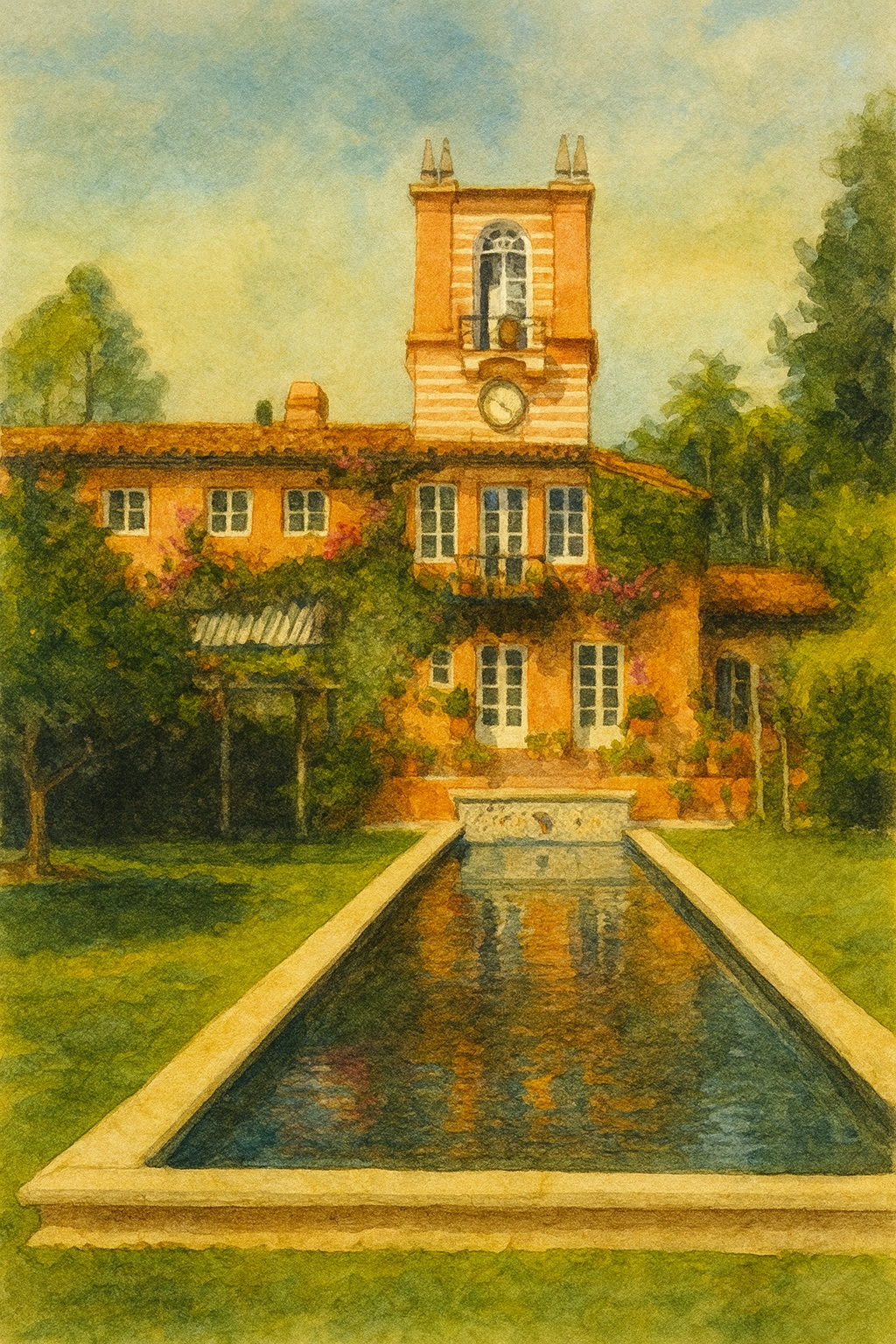
Castillo del Lago is not valuable because it is famous. It is valuable because it occupies a position that cannot be duplicated: elevated land above Lake Hollywood, commanding views, architectural authorship, and a visual identity strong enough to anchor an entire hillside. Built in 1926, the estate shows how form, site, and story combine to create long-term pricing power in the Hollywood Hills.
For buyers and sellers trying to understand why some properties consistently outperform their neighbors, Castillo del Lago is a working case study. This is not about lifestyle fantasy. It is about why certain homes become reference points in the market while others remain interchangeable.

Quick Facts
Address: 6342 Mulholland Highway, Los Angeles, CA 90068
Built: 1926
Architect: John DeLario, supervisory architect for the Hollywoodland development
Style: Mediterranean / Spanish Colonial Revival with Moorish detailing
Size: Approximately 10,500 sq ft across nine levels on roughly 2.7–3 acres
Market History: Acquired for approx. $5M (1993), $7M (2010), sold for approx. $18M in 2025
Why It Trades High: Architecture + elevation + narrative + visual dominance
Why this site matters more than the house itself
Castillo del Lago succeeds because the land does the heavy lifting. It sits above Lake Hollywood with layered sightlines, distance from traffic, and a silhouette visible from multiple approach angles. In hillside real estate, visibility without exposure is the holy grail. This property has it.
Buyers routinely over-focus on interior finishes. The market does not. Over long timeframes, homes that dominate their ridgeline, control their approach, and photograph cleanly from distance are the ones that continue to command premiums.
Architecture as a pricing multiplier
Designed by John DeLario, Castillo del Lago was conceived as a vertical composition, not a sprawl. The nine-level layout, entry tower, internal elevator, and stacked terraces turn the hillside constraint into a defining feature. This is not novelty. It is intentional scarcity.
Architectural authorship matters because it limits competition. A buyer shopping Castillo del Lago is not cross-shopping generic Mediterranean estates. They are buying a category. That distinction is what protects value during market corrections.
Narrative and its effect on market behavior
Castillo del Lago carries story, but story alone does not move pricing. What matters is that the narrative aligns with the architecture. From early oil wealth to pop-culture ownership, each chapter reinforced the same message: this is a property that exists apart from its neighbors.
In luxury real estate, narrative functions as memory. Buyers remember properties that feel distinct. Sellers benefit when a house is easy to recall without explanation. Castillo del Lago has that advantage.
Recent sales and what they actually tell us
The jump from $7 million in 2010 to approximately $18 million in 2025 is not simply market inflation. It reflects renewed demand for properties that offer something irreducible: elevation, authorship, and presence.
Notice what did not drive the price: square footage alone, bedroom count, or trend-driven interiors. What did drive it was positioning. Buyers at this level pay for certainty, not novelty.
What buyers should take from Castillo del Lago
If you are buying in the Hollywood Hills, prioritize homes that answer these questions clearly: Can this site be replicated? Does the architecture belong only here? Will the property still read as distinct in twenty years?
Castillo del Lago shows that when the answer is yes, the market responds consistently, even through economic cycles.
What sellers should learn from its performance
Sellers benefit when a home presents a coherent identity. Castillo del Lago never tried to be neutral. That clarity is what made it photograph well, market cleanly, and trade confidently at the top of its range.
The takeaway is simple: homes that know what they are sell better than homes that try to appeal to everyone.
Where it fits in the Hollywood Hills landscape
Castillo del Lago belongs to a small group of Los Angeles hillside properties that function as market anchors. Alongside the Ennis House, Sowden House, Moorcrest, and The Cedars, it demonstrates how architecture and site combine to create durable value.
These homes do not follow the market. They define it.
All home images are artistic illustrations used for educational and historical commentary.
